

Welcome to Geography
 Where we live impacts every corner of our lives. This spans from the quality of the air
we breathe and the water we drink, to our access to food, housing, healthcare, and
education. Geography examines how we shape, and are shaped by, place. It gives us
a deeper understanding of the world around us. Students who take geography courses
will learn that places are constantly reshaped by a combination of environmental processes
and cultural practices. They will learn to question how these places came to be and
think critically about how we might make them more equitable and sustainable.
Where we live impacts every corner of our lives. This spans from the quality of the air
we breathe and the water we drink, to our access to food, housing, healthcare, and
education. Geography examines how we shape, and are shaped by, place. It gives us
a deeper understanding of the world around us. Students who take geography courses
will learn that places are constantly reshaped by a combination of environmental processes
and cultural practices. They will learn to question how these places came to be and
think critically about how we might make them more equitable and sustainable.
Are you interested in understanding how climate change, inequality, politics, and activism unfold across local, national, and global scales?
Join us by taking a Geography course!
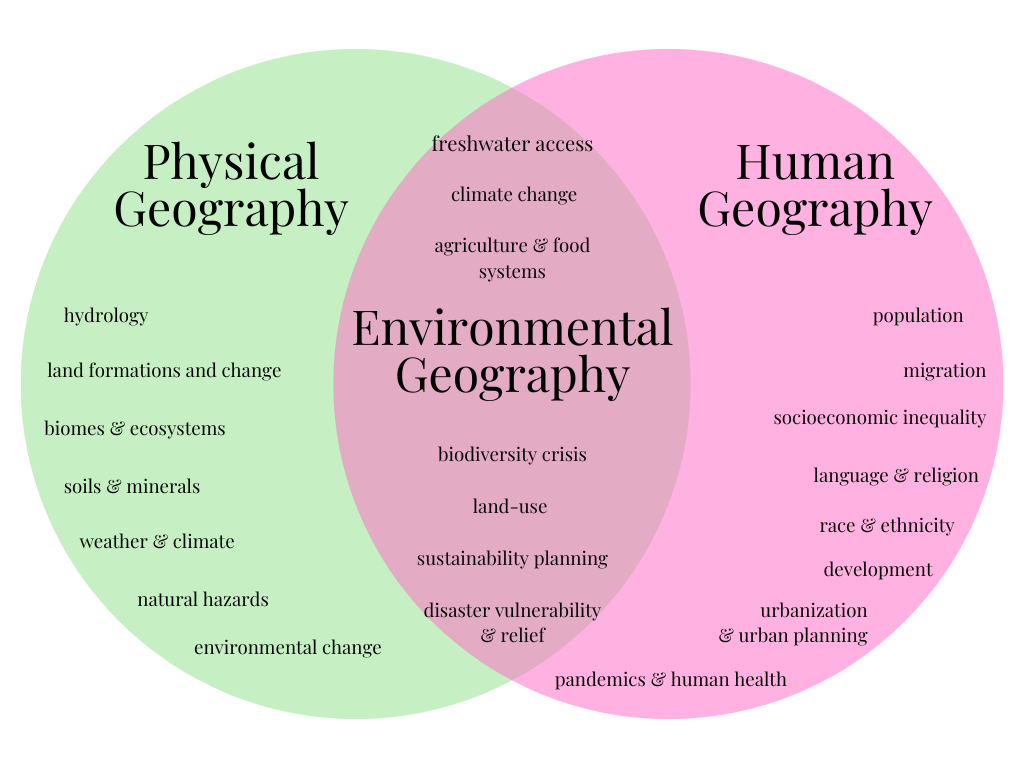
Image Caption & Credit: This Venn diagram shows some topics of study in physical and human geography and their overlap in environmental geography. When geographers study resources, climate change, agriculture and food systems, biodiversity crisis, land-use, sustainability planning, and disaster vulnerability (to name a few topics), they must bridge an understanding of both physical and human geography. Geographers sometimes study within discrete spheres, but it is common for geographers to focus on human-environment interactions (Creative Commons, CC BY-NC-SA; Aline Gregorio via Flickr).